I’ve been creating content for 13 years, and in that time I’ve seen how much damage “quick fix” SEO can do. My focus now is on intent-based SEO strategies — building content that answers real customer questions, earns trust, and drives leads. This space is for businesses that are tired of low-quality content and want a digital presence that actually works.
Attributes are the details that define what an entity really is — and they’re the missing link between meaning and rankings.
In semantic SEO, entities like people, products, or brands give Google a way to understand what your content is about. But it’s the attributes of an entity — the features, values, and qualities that describe it — that tell search engines how it’s different, why it’s relevant, and where it fits in context.
So when you search for “best phone with long battery life” or “laptop under $1000,” Google doesn’t just match words — it compares attributes. The result? Pages that clearly describe and connect an entity’s features and qualities tend to rank higher because they give Google the precision it needs to understand meaning.
What Are Attributes? The Anatomy of an Entity’s Identity
Attributes are the descriptive properties that give an entity its full identity. They tell Google and your audience what makes something distinct, useful, and relevant within its category.
As I explained in Entity SEO Explained – Meaning-Based Content Optimization, entities form the foundation of how Google understands topics. But on their own, they’re just the “who” or “what.” Attributes provide the “how” and “why” — the details that make an entity meaningful.
Every entity is shaped by three core dimensions:
Features – the tangible traits (e.g., display size, material, battery capacity)
Values – the measurable data (e.g., 6.1-inch screen, 256 GB storage, 20-hour battery life)
Qualities – the subjective characteristics (e.g., lightweight, durable, premium feel)
Without product attributes, “MacBook Air M3” would just be a label. With them, it becomes a defined, comparable entity in Google’s Knowledge Graph, one that Google can connect to search intent and rank with confidence.
How Attributes Connect Entities in the Knowledge Graph
Attributes do more than describe something. They help search engines see how things relate. For example:
Phone 15 → manufacturer → Apple
Apple → founded by → Steve Jobs
Now the iPhone is not just a phone. It is a product made by Apple, a company started by Steve Jobs. That simple web of facts gives Google context it can trust.
This matters most with product attributes. Price, material, battery life, weight, and similar details tell Google how items compare inside a category. Think “iPhone 15 vs Galaxy S24.” Clear, consistent attributes make that comparison easy to understand.
When your content spells out these details, Google can place it in the right spot. That placement improves how your page shows up for real searches.
Entities vs Attributes – Ranking Differences
Entities help Google understand what your content is about. Attributes help it decide how well your page answers a specific query. That difference is where ranking signals start to shift.
In other words, attributes:
Create Specific Relevance
Two pages might focus on the same entity — say, MacBook Air M3 — but the one that clearly lists its features, values, and qualities gives Google much stronger signals.
When a page spells out details like “13.6-inch Retina display,” “18-hour battery life,” and “1.24 kg weight,” Google can confidently match it to searches like “lightweight laptop with long battery life.” The completeness of those attributes makes the content more relevant, precise, and rank-worthy.
Strengthen Structured Data Signals
Attributes also translate naturally into structured data, which amplifies these signals. When attributes such as price, color, or rating are marked up in schema, Google can read them as defined data points rather than plain text. This improves how the page appears in search — from product carousels to knowledge panels and rich snippets.
Clarity Outranks Context
In short, entities establish context, but attributes provide clarity. They make your content easier for Google to interpret, compare, and display — which is exactly what improves visibility and ranking.
Optimizing Attributes for Better Visibility
If attributes help Google understand what makes something specific, optimizing them helps your content stand out. The goal isn’t to stuff details everywhere, but to use attributes in a way that builds clarity and trust — both for users and search engines.
Identify What Matters Most
Start by asking what details people actually compare or care about. In a product context, that usually means features, measurable values, and perceived qualities — the same building blocks that define an entity. Knowing what are content attributes in your niche helps you decide which traits deserve focus. For example, when writing about a phone, highlight battery life, camera type, and weight before less relevant specs.
Show, Don’t List
Attributes work best when they’re woven naturally into sentences instead of appearing as dry data.
Instead of: “The laptop has an 18-hour battery.”
Try: “The MacBook Air M3 lasts up to 18 hours on a charge, making it ideal for travel.”
That kind of phrasing gives Google clearer context and gives readers something they can relate to.
Use Structured Data Where It Counts
Add schema markup to describe key attributes like price, rating, availability, or brand. This helps Google connect those values directly to its Knowledge Graph. Structured data doesn’t replace good writing — it reinforces it by giving your attributes a defined shape in Google’s systems.
Keep It Consistent Across the Web
Google values consistency when evaluating entities and their attributes. Make sure the details on your site, product listings, and review pages match. Conflicting data signals weaken how Google perceives your authority.
Content Attributes – FAQ
What are attributes and types in SEO?
In SEO, attributes are descriptive details that define an entity, such as its features, values, or qualities. They help search engines understand content more precisely. Common types include on-page attributes (like alt text or schema properties) and entity attributes that describe things like products, people, or brands.
What are the four types of attribute data?
When creating briefs, product attributes can be grouped into four types: Simple Attributes – Single-value traits like color, brand, or model. Example: “Color: Midnight.” Composite Attributes – Combined features or specifications that include multiple elements. Example: “Display size: 13.6-inch Retina display.” Derived Attributes – Values calculated or inferred from other data. Example: “Battery life: estimated 18 hours based on average use.” Contextual Attributes – Clarifying or disambiguating details that define meaning or measurement. Example: “Storage capacity measured using base-10 units (1GB = 1 billion bytes).”
From the early 2000s to around 2012, SEO was mostly a numbers game. You could repeat a phrase like “best SEO tips” twenty times on a page, stuff it in the meta tags, and watch it rank. Search engines rewarded repetition because they didn’t really understand language — they just matched patterns.
That all changed when Google started teaching its algorithm to read more like a person. Three major updates flipped the script:
Panda (2011): Cleaned up thin, duplicate, and spammy content. It rewarded useful, original pages and punished keyword-stuffed ones.
Hummingbird (2013): Introduced true semantic understanding. Instead of focusing on individual words, it began interpreting the intent behind a search.
RankBrain (2015): Added machine learning. It helped Google connect new or unseen phrases to known concepts — essentially linking words to entities in the Knowledge Graph.
These updates have transformed SEO from a word-matching contest into a meaning-matching system — what we now call semantic SEO. It’s built around three key ideas: entities, attributes, and context. In this guide, we’ll focus on the first one — entities.
Entity SEO is the next logical step: optimizing your content so Google instantly knows what you’re talking about, who it helps, and how it relates to other ideas in its knowledge network.
This guide, Entity SEO Explained, breaks down what entities are, how they differ from keywords, and how you can use them to make your content clearer to both readers and search engines.
What Is an Entity in SEO? (Entities for Beginners)
An entity is something real that Google can identify, define, and connect to other facts — a product, brand, ingredient, or concept that exists beyond just a keyword.
Think about the AeroPress coffee maker. When someone searches for it, Google doesn’t just see the words “coffee press” or “manual brewer.” It recognizes AeroPress as a specific product made by Aerobie, linked to entities like coffee brewing, espresso alternatives, barista tools, and even World AeroPress Championship.
Because that entity is clearly mapped in Google’s Knowledge Graph, content that describes how it works, what it’s used for, and how it compares to similar tools has a much better chance of being understood — and ranked — correctly.
That’s what Entity SEO is really about: helping search engines grasp meaning, not just matching terms. When you write about a product like the AeroPress, you’re not just targeting “coffee maker” as a phrase; you’re building a clear network of context — materials, use-cases, features, and brand connections — that mirrors how the product exists in the real world.
It comes down to this: define the thing, describe what matters, and connect it naturally to related ideas. The more complete that picture, the easier it is for Google (and readers) to understand exactly what you mean.
What is a Knowledge Graph?
To understand how entities connect, it helps to start with knowledge graph basics — the system Google uses to organize information about the world.
The Knowledge Graph, introduced by Google in 2012, works like a giant digital map. Every entity — whether it’s a person, product, place, or concept — sits as a point on that map, connected to others through relationships. These links tell Google what something is, what it does, and how it relates to other things.
In other words, it lets Google answer questions and rank pages based on relationships, not repetition.
When your content mirrors how information is structured in the Knowledge Graph, it becomes easier for Google to place — and trust — it.
How the 4 Types of Entities Work in the Knowledge Graph
Google’s Knowledge Graph connects names, services and products through contextual info. The four main types that are the foundation of entity based SEO include:
Entity Type
Example
Role in the Knowledge Graph
How It Connects
Person / Organization
James Hoffmann (person) / Aerobie (organization)
Adds identity, credibility, and origin.
James Hoffmann is a coffee expert who uses and reviews products made by Aerobie.
Place
London
Provides location and context.
London is where James Hoffmann runs his coffee company and creates content about brewing.
Thing / Product
AeroPress coffee maker
Represents a physical entity people search for or use.
The Aeropress is manufactured by Aerobie and featured in Hoffmann’s brewing tutorials.
Concept / Idea
Home coffee brewing
Explains the topic or intent behind the search.
Connects all entities under one meaningful theme — how to brew better coffee at home.
Together, these entities form a simple but powerful map of meaning:
James Hoffmann → brews with → Aeropress → manufactured by → Aerobie → based in → London → linked to the idea of → home coffee brewing.
This is what Entity SEO Explained looks like in practice — defining what things are, showing how they relate, and giving Google a complete picture it can trust and rank.
What Is an Entity Match and Why It Matters for Rankings?
When Google fully understands what your page is about, it can link your content to the right concept in its Knowledge Graph — this connection is called an entity match.
An entity match happens when Google’s understanding of your content aligns perfectly with a known entity in its database. In plain terms, it means Google gets it. It knows the topic, the intent, and how your page fits within the bigger network of related ideas.
Here’s how it works in practice:
Example
What Google Sees
Result
Page Title: “How to Brew with an Aeropress”
Mentions and context align with the known entity Aeropress (product).
Google connects the article to the Aeropress entity in the Knowledge Graph, improving relevance for brewing-related searches.
Page Mentions: “Aerobie invented the Aeropress in 2005.”
Links two entities: Aerobie (organization) and Aeropress (product).
Strengthens the relationship between entities and helps confirm topical accuracy.
Supporting Info: “Popular among home coffee brewing enthusiasts.”
Adds the concept home coffee brewing (idea) and its user intent.
Expands semantic coverage and aligns the page with broader queries around coffee brewing methods.
When these connections are consistent — in your wording, schema, internal links, and context — Google doesn’t just see a keyword; it sees proof of understanding. The clearer your entities and relationships are, the more confidently it can match your page — and the higher it’s likely to rank. I explore the difference between keywords and entities in detail in Forget Keywords – Google Cares About Meaning Now.
Entities for Beginners – FAQ
What is an example of a weak entity?
A weak entity is one that lacks clear context or connections. For example, writing about “filters” without specifying whether you mean coffee filters, camera filters, or air filters creates ambiguity. Google can’t confidently map it in the Knowledge Graph, so it treats it as low-value or unclear content.
What’s the difference between keywords and entities?
Keywords are strings of text people type into search bars, while entities are the real things those words refer to — like people, products, or ideas. For instance, “coffee maker” is a keyword, but “Aeropress” is an entity. Keywords tell Google what was typed, entities tell it what was meant.
How to find SEO entities?
You can find relevant SEO entities by analyzing how Google describes your topic in tools like Google’s NLP API, TextRazor, or InLinks. You can also use Wikipedia, Knowledge Panels, or even Google Search itself — the “People also ask” and “About this result” sections often reveal recognized entities for your subject. For entities for beginners, start by identifying the real-world people, products, and concepts your content naturally connects to.
What is the 80/20 rule in SEO?
The 80/20 rule in SEO means that 80% of your organic results often come from 20% of your content. Instead of chasing hundreds of random keywords, focus on the few pages or entity-based topics that drive the most trust, links, and engagement. Strengthening those key pages amplifies your site’s overall authority.
For years, SEO felt like a numbers game — find the right keyword, repeat it enough times, and watch the page rise. But that game is over – relevance takes priority now. Search engines now think more like humans. They understand meaning, context, and intent, not just words on a page. That’s why a semantic SEO strategy matters — it helps both people and algorithms truly understand your content.
If you’ve noticed old keyword pages slipping in performance, this is why — and how to fix it.
Meaning > Matching
Search engines no longer look for matching phrases. They look for answers.
Google’s Hummingbird (2013),RankBrain (2015), and BERT (2019) updates introduced natural language processing (NLP) — letting algorithms interpret what a query means, not just what it says.
When someone searches “best camera for travel vlogging,” Google looks for entities like camera models, attributes like battery life or weight, and relationships like best for handheld video.
In short: Traditional SEO matches words. Semantic SEO connects concepts.
How Semantic SEO Creates Meaning for Search Engines
Semantic SEO is the process of structuring and writing content so search engines can understand its meaning and context. It’s built around three pillars:
Search Intent
Every search query carries an intention:
Informational: learn something
Navigational: find a brand or site
Transactional: make a purchase
Your job is to satisfy that intent — fully and clearly.
As Backlinko points out, content that aligns with search intent consistently ranks higher. When your post becomes the most helpful answer, you win both the click and the trust.
Entities and Relationships
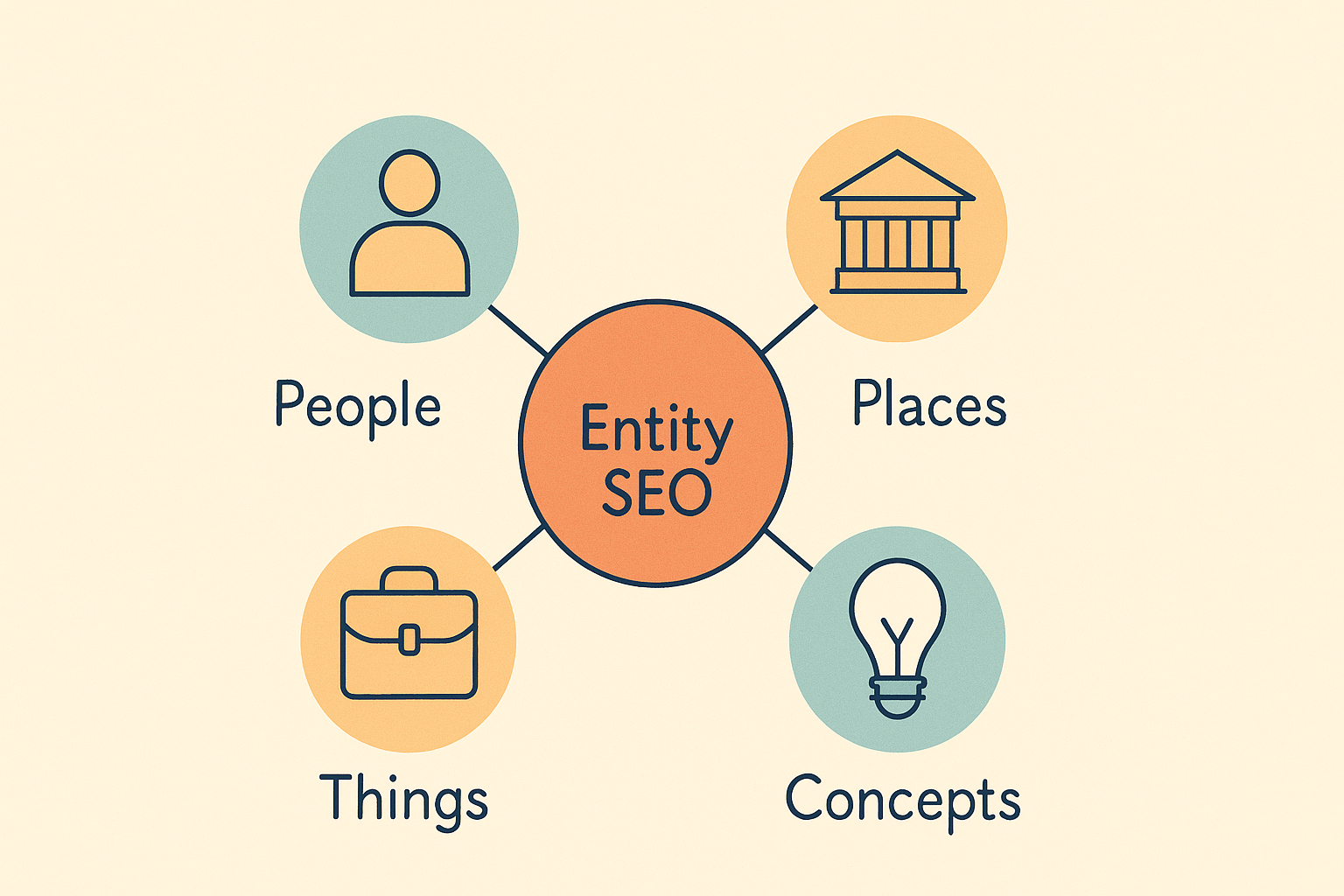
Google’s Knowledge Graph identifies “entities” — people, places, things, and concepts — and connects them through relationships.
For instance:
“Apple” could mean Apple Inc. or apple (fruit).
Google figures it out from surrounding entities: iPhone, Tim Cook, and MacBook signal the company; orchard or pie signal the fruit.
That’s entity SEO — giving Google enough context to know exactly what you mean. Use schema, headings, and internal links to clarify these connections. You’re not just writing words; you’re mapping knowledge.
Topical Authority
Instead of dozens of thin posts on small keyword variations, semantic SEO favors topic clusters:
A hub page covers the entire subject.
Several spoke pages go deep into subtopics.
For example:
Hub: “Semantic SEO Guide”
Spokes: “Entity SEO Explained,” “How to Build a Topical Map,” “Fix Keyword Cannibalization.”
This structure signals topical authority — that your site fully understands the domain. Over time, Google trusts you to rank for related queries automatically.
Why Keywords Are Fading (But Still Useful)
Keywords still matter — but only as a starting point. Use them as signals to shape your content, not as rules that restrict your wording.
Google Understands Context
A lot of people still think semantic SEO just means tossing a few synonyms into their content — like swapping “car” for “automobile” and calling it a day. It sounds easy, but that’s not how search works anymore. Google doesn’t care about word swaps; it cares about what you mean. With natural language processing, it looks for intent, context, and how your ideas connect.
Real semantic SEO isn’t about clever wording — it’s about helping Google (and your readers) see the bigger picture. That means covering subtopics, answering related questions, and using terms that naturally belong in the conversation. When you do that, your content doesn’t just sound right — it feels complete. And that’s what helps you build real topical authority.
Voice and Conversational Search Changed Everything
People now ask search engines real questions:
“Can I use a 65W charger for a 45W laptop?”
That’s not one keyword — it’s a concept. A single keyword won’t fit naturally here. A semantic SEO strategy lets you answer naturally and still rank, even when users phrase questions differently.
Structured Data Powers AI Overviews
When you use schema (like HowTo or FAQ), you tell Google exactly how your content fits into the Knowledge Graph. That’s why semantic pages appear in featured snippets, People Also Ask boxes, and AI-generated overviews.
Search Engine Journal found that pages using semantic structures are far more likely to earn rich results.
Google Rewards Meaning and Experience
Google’s E-E-A-T guidelines—Experience, Expertise, Authoritativeness, and Trustworthiness—align closely with semantic SEO. They reward content that demonstrates real understanding of a topic through clear explanations, credible sources, and contextual depth.
In other words, when your writing connects entities, shows first-hand experience, and helps users find meaningful answers, it signals both relevance and reliability to search engines. A Quick Example Old SEO:
“Best hiking shoes are important for hiking. Hiking shoes come in many types. The best hiking shoes are waterproof.”
Semantic SEO:
“The best hiking shoes depend on terrain, comfort, and activity type. Trail runners suit light paths; waterproof boots protect against rocky, wet trails.”
The second version adds semantic depth — entities (trail runners, boots), attributes (terrain, comfort), and context (wet trails).
That’s how Google learns you actually understand the topic.
How to Implement Semantic SEO Step-by-Step
Start with Intent — identify what the user truly wants.
Map Entities and Relationships — list related concepts your page should include.
Structure for Meaning — use clear headers and schema to show hierarchy.
Create Clusters — build a hub page and link your supporting content.
Write for People First — natural, conversational, helpful.
Update Often — refresh with new data, examples, and schema.
What is the difference between traditional SEO and semantic SEO?
Traditional SEO targets specific keywords and backlinks. Semantic SEO focuses on meaning and intent — connecting entities, attributes, and relationships so search engines understand the full context of your content.
What is an example of semantic SEO?
A page about “how to make cold brew coffee” that also explains ratios, grind size, and steep time. That semantic depth helps it rank for related queries like “coffee-to-water ratio” or “best beans for cold brew.”
What are semantic keywords in SEO?
Semantic keywords are contextually related terms — like “trail shoes,” “trekking,” or “footwear” for a “hiking shoes” page. They help Google grasp meaning beyond exact matches.
What is an example of a semantic search?
When you ask, “Can I use a 65W charger for a 45W laptop?”, Google interprets it as a question about power delivery, not just those words — that’s semantic search in action.
Does ChatGPT use semantic search?
Yes. ChatGPT relies on large language models trained to understand semantic relationships, much like search engines do. But it generates text rather than returning ranked web results.
If you’ve been treating SEO like a word-counting game, you’ve probably felt the results slipping. Search engines are not just matching phrases anymore. Google, for example, tries to figure out what your page is actually about, who it helps, and how the ideas connect.
That shift is what people call semantic SEO. Think of each page as a small, useful map. You name a real thing, describe the details that matter, and show how it relates to other things a reader cares about. When you do that, your content is easier for people to use and easier for search engines to trust.
This guide turns that idea into simple steps or a semantic SEO strategy. You will learn how to open with clarity, structure sections the way readers expect, avoid contradictions that confuse both users and crawlers, and build a site that concentrates strength instead of scattering it. No fluff, just practical moves you can ship today.
This guide draws on insights from the YouTube masterclass “Koray Tuğberk Interview: How to Rank #1 with Semantic SEO” with Koray, presented here in plain, practical steps you can ship.
Build Content Around Entities, Not Phrases
Semantic SEO – entity, attributes, relations
Search engines don’t just scan words anymore; they try to understand what those words refer to. In practice, that means they connect:
Entities (the things: a camera, a city, a disease)
Relations (how things connect: “A causes B,” “X is part of Y,” “Z works with Q”)
If your page reads like a mini “map” of these connections, it’s easier for a machine to understand—and easier to rank.
A quick before/after
Before (phrase):
“This camera is amazing and definitely the best you can buy.”
After (entity-based):
“Sony ZV-E10 (mirrorless, APS-C) with the 16–50mm kit lens records 4K/30 fps, supports USB-C streaming, and includes a directional 3-capsule mic—great for solo video creators filming at desktop distance.”
See the shift? We named the entity, listed attributes (sensor, lens, frame rate, mic), and tied it to a use-case. Now both humans and crawlers know exactly what this page is about.
Ship it (tiny checklist)
Name the main thing (entity).
List 5–8 attributes people actually care about.
Say who it’s for or what it’s used for.
Add one line linking the thing → the use-case (“why it fits”).
Match How People Actually Ask
Search systems love direct answers that mirror the shape of the question.
If someone asks “can/should/will…?”, start your answer with Yes, No, or It depends, then add steps or conditions.
For “how to” queries, lead with a clear sequence that a skimmer can follow.
Example
Query: “Can I use a 65W charger on a 45W laptop?” Answer: “Yes—if your charger and cable support USB-C Power Delivery. A 65W PD charger will negotiate down to 45W if that’s what your laptop requests. Use an e-marked cable and check the charger supports PD 3.0.”
It’s short, decisive, and safely nuanced—perfect for snippets and for real users.
Avoid Contradicting Your Own Content
If you call two different products “best” for the same context, you’re contradicting yourself. That muddles the “map” of your site.
Messy:
“Best budget e-scooter: Model A”
“Best budget e-scooter: Model B” (same criteria)
Clean:
“Best budget under $400: Model A”
“Best for hilly commutes: Model B”
“Best long-range: Model C”
Give each “best” a clear condition (price, terrain, range, size). That’s how you keep both readers and crawlers confident in your claims.
Follow Proven Content Patterns for Each Topic
Certain topics come with built-in “bundles” of sections. When you follow those bundles, your page aligns with how both people and systems expect the information to be organized.
Common bundles
Medical: definition → symptoms → causes → risk factors → diagnosis → treatments → when to seek help → FAQs
Software how-to: what it does → prereqs → step-by-step → options/parameters → troubleshooting → examples → FAQs
City guide: overview → neighborhoods → attractions → transport → costs → safety → itineraries → FAQs
When to split a section into its own page Only split if that section has real, independent search demand (for example, “iPhone 16 battery life”). Otherwise, keep the bundle together so users (and crawlers) see the complete picture in one place.
Make Your First 200 Words Do Real Work
The first 200 words of your content determine if a reader stays or leaves. It also ensures whether search engines can find your content or not. Use that prime real estate to state:
What the page is about (entity + type)
Numbers/attributes that matter
Who it’s for (audience or scenario)
What’s inside (a preview of sections)
Flat intro (meh):
“If you want to improve, this guide will help…”
Solid intro (useful):
“This V60 pour-over guide covers 15:1 coffee-to-water ratios, 92–96 °C water, 30–45 s bloom, and a 2:30–3:00 total brew for light-to-medium roasts. You’ll learn grind targets, spiral pouring, and fixes for sour or bitter cups.”
Now a reader (and a machine) immediately knows if this page is the right click.
Build Briefs The Semantic Way
Before writing, sketch a quick plan that mirrors how someone would evaluate your page against others. This prevents vague writing and ensures coverage that competitors cannot match.
For “Beginner’s Guide to Pour-Over Coffee,” you might note:
Must-cover questions: What gear? Which grind size? What ratio? What temperature? How long? Common mistakes?
Entities to include: V60, Kalita Wave, gooseneck kettle, filter types
Numbers to include: 15:1 ratio, 92–96 °C water, 2:30–3:00 brew, 30–45 s bloom
Fill your missing pieces naturally into your draft (don’t dump a list—place them where they belong).
Add one first-hand detail per major section (your photo, timing log, measured temps).
Make Site Navigation Easier for Users and Crawlers
Big sites often die by a thousand thin pages since these provide little value to readers. Instead, lean on hubs (comprehensive pages on a core topic) and spokes (focused sub-topics that link to/from the hub).
Example (home espresso)
Hub:Home Espresso Guide (machines, grinders, water, dialing in, maintenance)
Spokes:
Dialing In Espresso: A Step-by-Step
Water Chemistry for Espresso at Home
Flat vs. Conical Burrs (What Changes in the Cup?)
Backflushing & Descaling Schedule
Link the hub from your main nav or homepage—make it a quality node. Consolidate overlapping articles into one best page, and give that page the canonical URL.
Quick tidying wins
Merge duplicates and near-duplicates.
Use descriptive internal link anchors (“dialing in espresso,” not “read more”).
Keep sitemaps clean; avoid crawlers wasting time on junky parameter pages.
Fix Keyword Cannibalization and Adapt to Updates
Core updates can subtly shift how close two ideas are in the topic space (say, “install” vs. “set up”). Suddenly two of your pages might start competing for the same query. This is called keyword cannibalization which can confuse Google so it may not show your best content.
Signs to watch
GSC shows one query bouncing between two pages.
Rankings trade places week to week without other changes.
What to do
If they really answer the same intent, merge them into one stronger page.
If they serve different intents, make that difference loud and clear in the titles, H1s, intros, and internal links.
A Realistic Recovery Plan (Negative → Neutral → Positive)
If a core update smothered your traffic, use a calm, staged approach.
“For over-pronation: stability features & examples”
If a main guide starts getting long and cramped, move deep subtopics to their own pages and link to them from the guide. The guide stays clear and focused on the big picture, while each “spoke” page answers a specific, nuanced question in depth. This helps readers find exactly what they need and helps search engines understand and rank each page for its precise intent.
Let Tools Help, But Stay in Control
Tools are great at surfacing data. You’re great at making decisions.
Lightweight monthly loop
Pull queries with impression drops.
Re-read the affected page’s first 200 words: do they still name the right entity, attributes, and audience?
Run a quick entity gap pass and patch missing pieces.
Improve headings, steps, or tables for clarity.
Re-submit; note what you changed and why.
Over time, these small, steady touches beat big, infrequent overhauls.
A Small, Actionable Project to Get Started
Choose a narrow topic (e.g., “How to revive a dead sourdough starter”).
Use the template: definition → causes → step-by-step revival → time ranges → when to start over → FAQs.
Add numbers (ratios, grams, °C/°F, hours).
Include at least one original artifact (your photo, a timing log).
Compare with the top results; fill entity gaps.
Link it from a relevant hub (e.g., “Sourdough Starter Guide”).
Submit and watch which queries attach. Tweak the intro and subheadings to mirror those queries.
A semantic SEO strategy comes down to clarity. Name the thing and list the attributes that matter. Show how it fits real situations. Organize your site so the best pages are the easiest to find. Do that consistently and you’ll make life easier for readers—and for search engines that are trying to reason about the world, not just count words.
Have you ever searched for your business on Google and noticed that your competitors appear — but you don’t? This is one of the biggest frustrations for business owners in Lahore, Karachi, and Islamabad. Customers are searching every day for things like “lawyer near me Lahore”, “best salon in Karachi”, or “real estate agent Islamabad”. If your business isn’t showing up, you’re losing those customers before they even call.
And you’re not alone. On forums like Reddit, Pakistani entrepreneurs ask the same questions again and again: “Why isn’t my business on Google Maps?”, “How much should I pay for SEO in Pakistan?”, “Do reviews really matter for ranking?” The confusion is real, but the truth is simple: without proper local SEO, especially on-page optimization, your business will remain invisible.
The stakes are high. Pakistan now has 116 million internet users — about 45% of the population. And Google controls over 97% of the search engine market in Pakistan. That means nearly every online customer is using Google to find local businesses. At the same time, Pakistan lags behind globally in internet speed: the country ranks 128th in the world for mobile internet and 150th for fixed broadband. This makes slow websites an even bigger risk, because impatient customers leave quickly, and Google punishes poor site performance.
To make matters worse, Pakistan faces frequent internet disruptions and reports of restricted access to VPNs, which many people rely on to access X (formerly Twitter) and other blocked platforms. For businesses, this means online visibility must be strong enough to withstand an unpredictable digital environment.
This guide is here to solve that problem. Instead of theory, you’ll get practical on-page SEO tactics for local ranking in Pakistan. This includes:
Optimizing pages for city-specific searches in Lahore, Karachi, and Islamabad.
Using keywords the way Pakistanis actually search — in English, Urdu, and Roman Urdu.
Improving trust signals like reviews and optimizing your Google Business Profile.
By the end, you’ll know exactly what changes to make so your business can start showing up where it matters most: in front of your next customer.
For most business owners, SEO feels like technical jargon. But at its core, local search optimization is simple: it’s about making sure people in your city can find your business online when they’re ready to buy. Whether you run a salon in Lahore, a restaurant in Karachi, or a real estate agency in Islamabad, being visible in Google’s results can make the difference between getting a new customer or losing them to a competitor.
Google explains that its local results are based on three main factors:
Relevance → Does your website clearly explain what you offer?
Distance → Does Google know your business is actually located in Lahore, Karachi, or Islamabad?
Prominence → Do customers and other websites talk about and trust your brand (through reviews, citations, and links)?
In Pakistan, this plays out differently than in other markets because of how people search. Users mix English, Urdu, and Roman Urdu in queries. For example:
“best dentist Lahore”
“کراچی میں شادی ہال” (wedding hall in Karachi)
“islamabad car mechanic near me”
Each of these signals helps Google decide who appears in the map listings and local pack — those top results that get most of the clicks.
Competition also varies by city. Karachi businesses often face a crowded market across almost every niche. Lahore sees heavy demand for event services, education, and healthcare. Islamabad searches lean towards professional services, real estate, and consultancy. Understanding these patterns lets you fine-tune your on-page content so that Google sees you as the most relevant result in your area.
In short: ranking locally isn’t about chasing random website visitors. It’s about making sure the right people in your city can find and trust your business exactly when they’re searching.
On-Page SEO Foundations: Getting the Basics Right
Before worrying about advanced tricks, most businesses in Pakistan can boost their online visibility simply by fixing the basics. Think of your website as a shop: if the signboard is unclear, the shop is messy, and the doors are hard to open, customers will just walk away. Google works the same way — it rewards websites that are clear, organized, and helpful.
Here are the essential building blocks every business website should focus on:
Page Titles and Meta Descriptions
These are the first things people see when your site shows up in Google. A strong title should mention what you offer and where you’re located. For example:
“Affordable Event Photographer – Lahore”
“Best Car Workshop in Karachi – Trusted Since 2005”
The meta description is your sales pitch under the title. Keep it short (150–160 characters), highlight your main service, and add a local angle.
Headings (H1, H2, H3)
Headings are like chapter titles for your content. Use them to show Google and customers what’s important. For example:
H1: Wedding Planner in Islamabad – Full-Service Packages
H2: Why Clients in F-10 and Blue Area Choose Us
This tells both users and Google that your business is relevant to those locations.
Keywords That Match How Pakistanis Search
Don’t just repeat one keyword. Mix in variations and natural language. Example for a clinic in Lahore:
“best doctor in Lahore”
“best medical clinic near Gulberg”
“best ENT Lahore”
This makes your site relevant to the different ways and types of keywords your target customers use to search.
Mobile-Friendly and Fast
In Pakistan, most people go online through their phones, often on connections that are far from reliable. If your website is heavy, slow, or doesn’t display properly on mobile, visitors won’t wait — they’ll leave and choose a competitor whose site opens instantly.
Google also notices when a site loads poorly, and it pushes those websites down in search results. For a business owner, that means every extra second your page takes to load could be costing you calls, bookings, and sales — in fact, a site that loads in just one second converts three times better than one that takes five seconds, and five times better than a site that takes ten.
Clear Internal Links
Linking pages within your site helps customers and Google navigate. For example, your homepage should link to your services page or contact page. This strengthens your overall site structure. This is called internal linking — simply the practice of connecting one page of your website to another with clickable links.
Think of it like guiding a visitor around your shop: from the front door (homepage) to the service counter (services page), then to the checkout (contact page). It helps customers find what they need faster, and it also tells Google which pages on your site are most important, boosting their chances of showing up in search results.
Examples for local businesses:
A restaurant in Karachi linking its “Menu” page to the “Reserve a Table” page.
A wedding planner in Lahore linking the “Services” page to the “Contact Us for Packages” page.
A real estate agency in Islamabad linking each property listing to a “Book a Visit” page.
Tip for Business Owners: If you’re not sure whether your site is doing well on these basics, simply search your own business type + city in Google (e.g., “fast food restaurant Gulshan Karachi”). If your competitors show up and you don’t, chances are they’ve optimized these simple on-page elements better than you.
One of the most effective ways to improve your visibility in Google is by creating dedicated landing pages for each city you serve. If your business operates in multiple areas — for example Lahore, Karachi, and Islamabad — a single “Services” page is not enough. Google and customers both want to see content tailored to their location.
Here’s why this matters:
When someone searches “event planner in Lahore”, Google is more likely to rank a page that clearly mentions Lahore in its title, headings, and content — not just a generic services page.
Customers also feel more confident when they see details that speak to their city, like references to neighborhoods, landmarks, or even local testimonials.
Each landing page should have unique, locally relevant information. For example:
Clear title & headline: “Affordable Catering Services in Karachi”
Local references: Mention areas like Clifton or Gulshan for Karachi, Gulberg or DHA for Lahore, and Blue Area or F-10 for Islamabad.
Map embed: Add a Google Map with your exact location.
Photos: Real images of your business, staff, or local events.
Reviews: Display testimonials from customers in that specific city.
A common mistake is to copy the same text onto all three city pages and just swap the city name. Google can detect this, and it won’t reward duplicate content. Instead, write fresh content for each page. Share city-specific examples, case studies, or FAQs to make each one unique.
Content That Feels Local and Builds Trust
Once your website has the basics in place, the next step is to create content that feels specific to your city and audience. This is what convinces both Google and customers that you’re the right local choice.
What to Do
Why It Matters
Example for Pakistan Businesses
Share Local Stories
Shows customers you’re active in their city and builds credibility.
A wedding planner in Gulberg Lahore sharing how they organized an event in 30 days.
Write Guides for City Problems
Matches real search intent; brings targeted traffic.
Blog: “How to Protect Your Car During Karachi’s Monsoon” or “Checklist for Renting a House in Islamabad F-10.”
Use Multiple Languages
Captures searches in English, Urdu, and Roman Urdu.
“best cake shop Lahore” + “لاہور میں بہترین بیکری”
Showcase Reviews & Testimonials
Builds trust and improves local ranking signals.
Display feedback from actual customers in DHA Karachi or Blue Area Islamabad.
Mention Landmarks & Neighborhoods
Helps both Google and customers recognize your local presence.
“Our clinic is just 5 minutes from Liberty Market, Lahore.”
Add Real Photos
Makes your business feel authentic, not stock-image based.
Photos of your team working at an event in Lahore or delivering orders in Karachi.
Technical & On-Page Enhancements
Once your content feels local, the next step is to add the behind-the-scenes improvements that help Google understand your business better. These don’t require coding skills — most can be handled by your web developer, SEO partner, or even with free tools.
Enhancement
Why It Matters
Example for Local Businesses
Local Schema Markup
Tells Google exactly what your business is (type, location, services). Helps you qualify for rich results.
A salon in Lahore adds “LocalBusiness” schema so Google shows its opening hours and ratings in search.
Google Maps Embed
Shows customers where you’re located and increases trust signals.
A restaurant in Karachi embeds its location on the “Contact Us” page.
Image SEO
Optimized images load faster and rank in image search.
A real estate agency in Islamabad names its photo “house-for-rent-f10-islamabad.jpg” instead of “IMG1234.jpg.”
FAQ Sections
Answering common questions helps with voice search and can appear in Google’s “People Also Ask.”
A clinic in Lahore adds FAQs like “Do you offer evening appointments in Gulberg?”
Internal Linking Strategy
Guides customers to take action and signals importance to Google.
A wedding services page in Karachi links to “Book Consultation” and “Gallery” pages.
Tip for Business Owners: You don’t need to do everything at once. Start with the quick wins: embed your Google Map, add customer FAQs, and rename your images with city and service keywords. These alone can give you a noticeable lift in local search.
Frequently Asked Questions
How long does it take to see results from local search optimization in Pakistan?
Most businesses in Lahore, Karachi, or Islamabad start noticing improvements within 3–6 months if their website and Google Business Profile are properly optimized. Quick wins like adding reviews or fixing basic site errors can show impact sooner.
Do I need separate websites for different cities?
No — one website is enough. Instead of building multiple sites, create city-specific landing pages for Lahore, Karachi, and Islamabad. This keeps your site stronger and avoids duplicate content issues.
Is social media important for local search ranking?
Yes, but indirectly. While Facebook or Instagram likes don’t push you up in Google, an active presence helps build trust. In Pakistan, many customers check your social profiles before contacting you, so it supports your SEO efforts.
Can online reviews really affect my Google ranking?
Absolutely. Positive reviews on your Google Business Profile act as trust signals. In competitive markets like Karachi or Lahore, businesses with more consistent reviews often outrank those with weak or no feedback.
What’s the difference between SEO services in Pakistan and hiring an international agency?
Local SEO services in Pakistan usually understand city-specific behavior better — for example, how people in Islamabad search in Roman Urdu or how Karachi users prioritize map listings. International agencies may have advanced tools, but they often miss these local nuances.
Do Urdu or Roman Urdu keywords matter for local SEO?
Yes, especially for industries like retail, food, and services. Many Pakistanis type searches in Roman Urdu, such as “acha tailor Lahore” or “cheap hall Karachi.” Adding a few phrases naturally into your content can capture this traffic.
Is it worth paying for local SEO if I already run ads?
Yes. Paid ads stop the moment you pause your budget, while organic local SEO builds long-term visibility. Many smart businesses in Lahore and Islamabad use both together for maximum reach.
Ready to Boost Your Local SEO in Pakistan?
Getting found online doesn’t stop here. Along with the on-page steps we’ve covered, check out our guide: 10 On-Page SEO Ranking Factors You Can’t Ignore in 2025. It’s packed with practical tips you can apply right away to strengthen your visibility in Lahore, Karachi, Islamabad — and beyond.
In Pakistan’s digital economy, competition for visibility is rising sharply. Whether you operate an e-commerce store in Karachi, a clinic in Lahore, or a consultancy in Islamabad, your customers are searching online first—and they rarely scroll past the first results page. This is where SEO for small businesses come in.
Google’s ranking systems in 2025 are driven by two main ideas:
Can this page give the user the right answer quickly?
Is this business credible and trustworthy?
Recent updates from Google Search Central emphasize user intent, page experience, and structured content as core signals. Add to this the rapid adoption of mobile internet in Pakistan (over 198 million broadband subscribers as of July 2025, according to the Pakistan Telecommunication Authority), and the case for investing in strong page optimization and on page SEO becomes clear.
On-Page SEO Ranking Factors 2025
Search Intent Aligned With Pakistani Users
Ranking well in Google starts with matching intent. A user searching “dentist in Lahore” expects clinic information, not a generic blog post about dental hygiene. Failing to meet intent means Google will quickly demote your page.
In Pakistan, intent is often hyper-local and transactional. Research by Think with Google shows that “near me” searches have exploded worldwide, and Pakistan is no exception. If your website doesn’t serve these intents clearly—address, services, booking forms—you’ll miss local opportunities.
Optimized Title Tags With Local Angle
Title tags remain one of the most powerful signals. Keep them under 60 characters, and include relevant local modifiers. For example: “SEO Services in Karachi – Affordable Packages for SMEs.” A specific, city-focused title speaks directly to your audience and improves click-through rates.
Effective Meta Descriptions
Meta descriptions do not directly influence rankings, but they impact click-through rates. According to Yoast, well-written descriptions can increase clicks by 5–10%.
In Pakistan, where users often compare multiple businesses before clicking, descriptions should highlight unique trust points: affordability, certification, or cash-on-delivery availability.
Structured Headings (H1–H3)
Headings guide both readers and search engines. A proper H1 introduces the main topic, while H2s and H3s organize supporting points. Google emphasizes this in its SEO documentation—headings should reflect structure, not just visual style.
High-Quality, Original Content
Google’s algorithms evaluate originality, depth, and relevance. For Pakistani businesses, this means addressing real-world concerns: delivery delays in Karachi, Cash on Delivery options, or seasonal promotions around Eid.
The State Bank of Pakistan notes that consumer trust remains a challenge in e-commerce. Content that transparently answers these concerns builds both trust and rankings.
Internal Linking Strategy
Internal linking is just a way of connecting your website pages so visitors and Google both understand your business better. For example, if you run a restaurant in Karachi and write a blog about “Top 5 Iftar Deals in Karachi,” you should link it to your main Ramadan Offers page, which then links to your Menu page and finally to your Table Reservation page.
This simple chain does two things:
It keeps visitors moving through your site instead of leaving after one page.
It shows Google which pages are most important, helping them rank higher in Pakistan’s search results.
Image Optimization for Local Conditions
In Pakistan, internet speeds can vary a lot, and slow-loading images often cause visitors to leave before your page even appears. A large picture of your product might look good, but if it takes too long to load on a mobile network, you’ll lose potential customers.
The solution is simple: compress your images so they’re lighter, use modern formats like WebP, and add clear alt text (for example, “men’s leather shoes Karachi” instead of “image1.jpg”). This way, your site loads faster, stays visible in Google, and gives users a better experience—no matter their connection speed.
Mobile-Friendly Experience
Picture this: a student in Lahore searches “best IELTS institute near me” on her Android phone. She clicks your website, but the text is too small, the menu buttons overlap, and she has to zoom in just to find your contact form. Within seconds, she hits the back button and chooses a competitor.
This is the reality for many Pakistani businesses—more than 80% of traffic is mobile, but sites are still designed for desktops. To win, your site must adapt seamlessly to all devices. That means bigger fonts, easy-to-tap buttons, and layouts that work on mid-range Android phones, not just the latest iPhones. If your website isn’t mobile-friendly, you’re effectively invisible to most of your market.
Answer-First Content Design
Pakistani users don’t have time for fluff. When someone searches “how to renew driving license in Karachi”, they want the steps immediately—not a long intro about the history of licensing.
That’s why answer-first content works. Start each section with a clear, direct response (2–3 sentences), then expand with more detail. This approach not only keeps readers happy but also increases your chances of appearing in Google’s featured snippets or AI summaries. The result? Your business gets visibility even above the traditional #1 spot.
Content Freshness
Global and local search trends move with the seasons. During Ramadan, searches for “iftar deals Karachi” spike. Around PSL, sports-related queries dominate. If your website ignores these shifts, you’ll miss out on valuable traffic.
Freshness also matters for evergreen content. A blog titled “Fashion Trends in Pakistan 2022” looks outdated in 2025, even if the advice is still solid. Updating statistics, adding new examples, and showing you’re aware of local events signals both to Google and your audience that your content is alive, not abandoned.
Turn On-Page Improvements Into Real Growth
For Pakistani businesses, success online isn’t about chasing shortcuts—it’s about building a clear, and trustworthy online presence. Each of the 10 factors above contributes to how your brand is seen by both Google and potential customers. When SEO for small businesses is applied consistently, they create a foundation that supports higher rankings and stronger conversions.
To see how these elements fit into a broader framework, explore our full guide on On-Page SEO Basics for Pakistani Businesses. Combined with the on-page SEO ranking factors 2025, this approach will help your business stay competitive and earn long-term visibility in Pakistan’s fast-moving digital market.
As a tailor who has kareegar (workers) to pay and mouths to feed at home, you know competition is tough. Har konay may ek darzi hai — with a tailor around every corner in residential areas, how do you stand out and attract customers?
How do you appear when someone nearby urgently needs a suit stitched?
The answer is simple: by ranking in local search results and appearing prominently on the search engine results page. Today, most people don’t ask neighbors for recommendations—they pull out their phones and type things like “ladies tailor near me” or “best tailor in Karachi.” The businesses that show up in Google’s search results, supported by accurate details and positive Google reviews, get the next customer, while the rest are ignored.
Important note: If you try searching this keyword yourself, you’ll see different results depending on which tailors are closest to you
What are ‘Near Me’ Searches?
When someone nearby needs clothes stitched quickly, the first thing they do is grab their phone and type “best tailor near me” into Google. These are called “near me” searches, and they help people find the closest, most trusted shop fast.
Think about it: before Eid-ul-Fitr, everyone is rushing to get new clothes ready. Before Eid-ul-Adha, families want fresh outfits for gatherings. And wedding season in Pakistan is non-stop, with customers needing full joras, sherwanis, and bridal dresses stitched on time. In all these cases, people search for tailors close to them instead of traveling far.
The good news? You don’t need a website to show up in these results. Many tailors are already appearing in “near me” searches just by creating a Google Business Profile, keeping their shop details up to date, and collecting reviews from happy customers.
That way, when someone nearby needs a suit stitched for Eid or a wedding, your shop can appear right on their phone. Just look at Zauk’s Google Business Profile. Even without a website link, they are still showing up for “best tailor near me.”
How Zauk is Ranking for ‘Best Tailor Near Me’ Searches
Here are the local SEO strategies that help this tailor rank for ‘best tailor near me.’
They List All Areas Served
Zauk shows exactly where they work. This includes cities like Karachi, Lahore, and Islamabad. They also list countries like the UAE, Oman, the UK, US, Canada, Australia, Malaysia, parts of Europe and the Middle East.
This helps Google connect them with customers nearby or even from other countries. For tailors, listing all the areas you serve makes it easier for people to find you. It also shows that your shop is professional and organized.
Tip for tailors: Add all the areas you serve in your Google Business Profile. Even small neighborhoods count. This makes it easier for local customers to find you and builds trust.
They Respond to Reviews
Zauk has more than 150 positive reviews, and even simple responses like a “Thank you” help a lot. Google sees this as a sign that the business is active and cares about its customers. For tailors, replying to reviews, even a short message, builds trust and can improve your ranking for “near me” searches.
Tip for tailors: Ask satisfied clients to leave reviews. Learn how to encourage customers to leave reviews naturally by mentioning it in person or sending a polite follow-up. Replying even briefly shows professionalism and helps you rank higher for ‘near me’ searches
They Post Clear Pictures and Videos of their Work
High-quality photos and videos of stitched clothes give customers a real look at what they can expect. This builds confidence before someone even steps into the shop. For tailors, sharing your best work visually can make a big difference in attracting new customers.
Tip for tailors: Share your best work regularly. Include different angles, fabrics, and finished outfits so potential clients can see the quality and style you offer.
They Answer Questions in the Q&A Section
Zauk has answered customer questions in their Google Business Profile, though their last answer was six years ago.
Even occasional responses show potential customers that the shop is approachable and professional. Tailors who take a few minutes to answer common questions about pricing, delivery times, or designs can boost trust and make it more likely people will visit their shop.
Tip for tailors: Take a few minutes to answer common questions about pricing, delivery, or designs. This helps customers feel confident and increases the chances they will visit your shop.
They Have Clear and Consistent Business Details (NAP)
Zauk has clearly mentioned their Name, Address and Phone Number (NAP) in their Google Business Profile. This helps Google understand exactly where their shop is located and shows customers that the information is reliable. For tailors, having consistent and clear NAP details across all listings builds trust and makes it easier for people nearby to find your shop.
Tip for tailors: Double-check that your name, address, and phone number are exactly the same everywhere online. Even small differences can confuse Google. For example, a missing digit or a slightly different spelling can make it harder for customers to find you.
How Other Pakistani Businesses Can Rank for Near Me Searches
Zauk has a website, but it hasn’t been claimed in their Google Business Profile. Even without claiming it, they still rank for near me searches. Their profile is complete with accurate business details, photos, and reviews.
This shows that even small tailors can achieve this by optimizing their Google Business Profile. Give customers the right information, and they will find you. You don’t need expensive ads you probably don’t have a budget for.
In Pakistan, people often search for tailors nearby, especially before Eid, weddings, and other special occasions. Appearing in these searches can bring customers straight to your shop without spending on ads.
Here is a simple breakdown of tips that can help any Pakistani business, especially tailors, get found and trusted by nearby customers:
Action
Why It Matters
How to Do It
Claim & optimize Google Business Profile
Helps your shop appear in local searches
Add shop name, address, phone, hours, photos, and categories
Collect customer reviews
Builds trust and boosts ranking
Ask satisfied clients politely in person or via follow-up; respond even briefly
Add clear photos/videos of work
Shows quality and expertise
Post high-quality images of stitched outfits and videos of your work
Answer questions in Q&A section
Shows professionalism
Reply to common questions about pricing, delivery, or designs
List all areas served
Helps Google show you to nearby customers
Include all neighborhoods, cities, and regions you serve accurately
Maximize Your Google Business Profile for Local Success
By following these steps, tailors can get noticed more easily, build trust with customers, and compete with bigger shops in their area. A well-optimized Google Business Profile helps achieve quick local SEO results.
However, maintaining a steady flow of customers over time usually requires a slightly deeper approach. Simple actions can make a big difference for long-term visibility. These include using the right keywords, keeping your profile accurate, and organizing your content clearly.
This guide helps tailors get more consistent traffic. It covers on-page SEO for Pakistani businesses, including keywords, content, user experience, technical details, and visuals. It explains a simple SEO framework that can help you attract more customers directly from Google search.
SEO in Pakistan is one of the most misunderstood parts of digital marketing. Many SME owners still think of it as an expense they can avoid. I’ve heard it countless times: “kon parhay ga blogs? mujhay to instant leads aur sales chahiyay.” It’s an understandable concern — but it misses how customers actually behave online today.
Yes, social media campaigns can get you some quick attention, but they’re only the start. The moment you stop paying for ads, the visibility is gone. SEO, on the other hand, keeps working in the background to bring you steady traffic.
Take Daraz as an example. As per a quick domain analysis on Semrush (July 2025), Daraz gets over 6.7 million organic visits every month, ranks for more than 615,000 keywords, and has built authority with 2.9 million backlinks.
Daraz SEO in Pakistan
That kind of reach isn’t the result of just ads or influencers, it’s the payoff of consistent search optimization.
For smaller businesses, the takeaway is simple: SEO isn’t about writing random blogs that nobody reads. It’s about showing up when your customer is typing a query into Google. In this guide, we’ll walk through a beginner SEO strategy and a practical on page SEO checklist to help you fix low traffic and start getting customers from Google search — without needing a massive budget.
Running a small business here isn’t easy. Most owners are busy managing day-to-day work, so online visibility often gets ignored. A few common patterns show up again and again:
Too much reliance on social media Many SMEs depend only on a Facebook page or the occasional boosted post. It brings quick attention, but nothing long-term.
Budgets are short-term Once the ad spend stops, so does the traffic. There’s no backup plan to keep customers coming in.
Customers can’t find them People search online before buying almost everything now. If your business doesn’t show up, they’ll simply pick someone else.
Credibility gaps A business that shows up on Google with reviews and helpful content looks more trustworthy than one that only appears in random social media ads.
The truth is, building a steady online presence doesn’t always need a huge budget. What it does need is a bit of planning and consistency. Small, regular steps can make a big difference over time.
You don’t need to be an SEO expert to make real improvements. What you need is a clear, practical process that actually fits a small business budget. Here’s how I usually explain it to SME owners:
Understand your audience Don’t guess what people search for — listen to them. If you run a salon, your customers aren’t typing “premium beauty services Karachi.” They’re searching for specific services, things like “best bridal makeup near me” or “affordable haircut PECHS.”
Fix your website basics Many Pakistani SME websites load slowly, especially on mobile. If your site takes 7–8 seconds to open, most people will leave. Use free tools like Google PageSpeed Insights to check. Another example: a restaurant website with no phone number or map link loses customers instantly. Basics like these make a real difference.
Create useful content Content doesn’t have to mean long blog posts. A clothing store can create size guides or care tips for fabrics. A plumber can write a short post on “how to check if your water pump needs repair.” These practical answers build trust and show up in search results.
Use a checklist To keep things structured, follow an on page SEO checklist. For example, make sure every page has:
A clear title (e.g., “Bridal Makeup in Islamabad – XYZ Salon”)
A meta description that explains what the page is about
At least one image with proper alt text (instead of “image1.jpg,” use “bridal-makeup-islamabad.jpg”)
Internal links to other services or related posts
Be consistent SEO is slow if you treat it like a one-time task. A bakery posting one new recipe or promotion a month will eventually build steady traffic. Compare that to a competitor who posts nothing for a year. Guess who shows up in search results first?
The big idea: SEO is less about doing everything at once and more about doing the right small things regularly. That’s what makes a business discoverable when customers are searching.
On-page SEO simply means the things you can control on your own website — the words, structure, and design that help both people and Google understand what your page is about.
In 2025, this matters more than ever. Google’s algorithms now focus heavily on clarity, speed, and relevance. If your website is slow, confusing, or unclear, it won’t rank well no matter how much you spend on ads.
Here’s where many Pakistani SMEs run into trouble:
A business owner complains “meri website pe traffic hi nahin aata” (I don’t get any traffic on my website). Often, the issue isn’t lack of demand — it’s poor on-page SEO.
Titles are vague (e.g., “Home” instead of “Bridal Makeup Services in Karachi – XYZ Salon”).
Pages load slowly, especially on mobile, leading customers to drop off.
Content is written for search engines, not people, so it fails to connect with real customers.
When these basics aren’t in place, businesses see low traffic and wasted investment. Fixing them is the foundation of any beginner SEO strategy.
Think of this checklist as a roadmap. If you’re running a small business, you don’t need to master every detail, but getting these essentials right will make a huge difference.
Keyword Placement
Title tags and meta descriptions: Use your main keyword naturally in the title and meta. Example: “Best Plumber in Rawalpindi – QuickFix Services.”
Headers and first 100 words: Google pays attention to early signals. If you’re writing about bakery services, say it upfront instead of hiding it halfway down the page.
Local + bilingual relevance: Don’t ignore how local customers actually search. Mix in Roman Urdu phrases where it makes sense. Example: “best mehndi artist near me” alongside the English version.
Content Quality
Write for humans first: Avoid keyword stuffing. A customer searching for “water pump repair” wants clear solutions, not repeated keywords.
Use examples and data: If you run a clothing brand, add size guides, fabric care tips, or even short customer stories.
Add E-E-A-T signals: Show who wrote the content (an “About the Author” box), cite credible sources (industry data, Google updates), and make it clear you have real experience in the field.
User Experience & Design
Mobile-friendly design: In Pakistani users are on mobile. If your buttons are tiny or your text is unreadable, customers won’t stay.
Easy navigation: Keep menus simple. A restaurant site should have clear tabs like Menu – Location – Order Online instead of clutter.
HTTPS security: Google favors secure sites, and customers trust them more.
Core Web Vitals: According to Backlinko, Google began using page speed as a ranking factor in 2010 and gave it greater importance in 2018 with the Speed Update. In plain words, a slow website hurts your chances of showing up. If your site takes too long to load, freezes while scrolling, or shifts content around because of ads, Google pushes it down. In Pakistan, where internet speed is the world’s slowest and many people use mid-range phones, speed is even more critical. A site that lags can lose a customer before the page even opens.
Internet Speed in Pakistan 2025
Visual & Media Optimization
Use original images: The last thing I need to see is a staged, AI generated stock photo when I research ‘laptop repairs near me.’ Pakistani audiences connect better with real shop photos, your own staff, or actual products, not stock photos of smiling models!
Optimize alt text: Describe images in plain words with a keyword where natural. Example: “bridal-makeup-lahore.jpg – Bridal makeup look done by XYZ Salon in Lahore.”
Most business owners get stuck because SEO feels “too technical.” But if you break it down into small, clear actions, it becomes manageable. Here’s how you can apply the checklist in real life:
Start with one page at a time Example: If you own a restaurant in Lahore, begin by optimizing your Menu page. Add a clear title like “BBQ Menu – ABC Restaurant Karachi” and a short description that includes your specialty dishes. No need to fix the whole site in one go.
Use customer language, not business jargon A Karachi tailor might describe services as “premium stitching solutions.” But customers usually search for “best ladies tailor Karachi” or “shalwar kameez stitching near me.” Rewrite your page titles and headings in the words your customers actually use.
Add local signals A small clinic in Islamabad can include a map, photos of the waiting area, and reviews from patients. Google uses these as trust signals. Plus, real images resonate more with local audiences than stock photos.
Fix the basics before running ads A bakery in Rawalpindi may spend on Facebook promotions but still complain that website visitors don’t order. The issue often lies in missing “Order Now” buttons, unclear contact info, or pages that don’t load on mobile. Fixing these basics improves conversions without extra ad spend.
Stay consistent One blog post or update a month is enough to build momentum. For example, an auto workshop could publish short guides like “5 signs your car battery is dying.” Over time, these posts become entry points for new customers.
The key is to treat SEO as ongoing maintenance, not a one-time project. Just like keeping a shop clean and stocked, your website needs small, steady improvements to stay visible.
For most SMEs, the customer journey starts with a simple search. Someone types “best cupcakes near me” or “AC repair Lahore.” They click a result, land on a website, decide if they trust the business, and then either visit, call, or buy. If your online presence guides them through each step, you turn searches into sales.
Here’s how SMEs can make that happen:
Encourage reviews from real customers Positive reviews on Google Business Profile act like word-of-mouth online. A salon in Karachi that regularly asks happy clients to leave feedback is far more likely to show up in “salon near me” searches.
Answer questions with FAQs People often search in natural language, especially with voice search. An electrician can add an FAQ like “Do you offer emergency repair services?” so they appear when someone asks Google the same thing.
Make it easy to act Add simple calls-to-action (CTAs) such as “Call Now” and “Get Directions” on both your website and Google Business Profile. A restaurant in Lahore with a clickable phone number and direct map link will always get more walk-ins than one that hides contact info.
For many SMEs, this approach works as a beginner SEO strategy. It’s simple, low-cost, and effective in bringing customers directly from Google search.
What is the best beginner SEO strategy for Pakistani SMEs? The best beginner SEO strategy is to focus on the essentials: optimize your Google Business Profile, publish localized blogs that answer customer questions, and ensure your website works smoothly on mobile.
How do I fix low traffic on my business website? Low traffic is usually the result of unoptimized content, slow site speed, or missing local signals. Use an on page SEO checklist to update title tags, write stronger descriptions, and improve loading times.
Can SEO really help me get customers from Google search? Yes. Customers in Pakistan are actively searching for services online. By ranking for terms like “AC repair near me” or “best tailor in Karachi”, you can get customers from Google search without relying only on ads.
Why is SEO in Pakistan important in 2025? More than 90% of online experiences start with a search. For SMEs in Pakistan, SEO is the difference between being found or being invisible. Ads bring short-term results, but SEO builds a steady flow of visitors and leads over time.
What should I include in my on page SEO checklist? Your on page SEO checklist should include:
Keywords in titles, headers, and first 100 words
Clean URLs and HTTPS
Fast mobile performance
Quality content backed by sources
Clear calls-to-action (CTAs) like “Call Now” or “Get Directions”
How long does it take to see SEO results? For most Pakistani SMEs, early improvements show within 3–4 months if the basics are done right. Stronger authority and consistent traffic growth often take 6–12 months.
Is SEO expensive for small businesses? Not necessarily. Many fixes like optimizing your Google Business Profile, writing FAQs, and speeding up your website cost very little. You can start small, then scale into advanced SEO as you grow.
How do reviews affect my SEO in Pakistan? Reviews play a huge role. A business with consistent positive Google reviews often ranks higher in “near me” searches. For instance, a salon in Islamabad with 100+ reviews will usually appear before a salon with only 5 reviews.
Do backlinks still matter in 2025? Yes, but quality beats quantity. A link from a trusted site like DAWN or ProPakistani is far more valuable than dozens of random directory links. Focus on partnerships, guest posts, and media mentions.
Is SEO just about keywords? No. Keywords help Google understand your content, but rankings depend on many other factors like site speed, mobile experience, trust signals, and backlinks. Think of keywords as the starting point, not the whole game.
Can I do SEO once and forget it? No. SEO in Pakistan (and everywhere) is an ongoing process. Algorithms change, competitors improve, and customer behavior shifts. If you stop updating your site, your rankings will drop over time.
Do I need to buy backlinks to rank? Not at all. Buying backlinks often backfires and can even get your site penalized. Earning backlinks naturally through strong content, partnerships, and PR is far more effective.
Is social media a replacement for SEO? Social media helps with visibility, but it’s not a replacement. A boosted Facebook post might give you leads for a few days. SEO ensures people can still find you on Google months or years later, even when you stop paying for ads.
Can small businesses in Pakistan compete with big brands in SEO? Yes. Local SEO levels the playing field. For example, a small bakery can rank higher than a national chain for searches like “best cupcakes in Gulshan” if it optimizes its Google Business Profile and gathers positive reviews.
Does SEO take years to work? No. Some results show in weeks if you fix the basics (like NAP consistency or on-page SEO). Bigger results take time, but you don’t need to wait years to see progress.
SEO for Pakistani businesses is no longer optional—it’s essential. Whether you run a boutique in Lahore, a clinic in Karachi, or a startup in Islamabad, your customers are already searching online. The question is: will they find you, or your competitor?
The truth is, you don’t need a massive budget to get started. A beginner SEO strategy—like optimizing your Google Business Profile, speeding up your website, and publishing content that answers local customer questions—can set you apart faster than most SMEs realize.
Think of SEO as a long-term investment. Social media campaigns give you quick visibility, but SEO builds a foundation that keeps bringing customers month after month. By focusing on clarity, trust, and consistency, SMEs in Pakistan can turn their websites into reliable engines for growth.




Leave a Reply